In Part 1 and Part 2 of this series we concentrated on the relationship between the DDVE software running on EC2 and its target datastore, S3. As with anything cloud based permissions and IAM play a critical role and then we delved into the techniques used to securely connect to S3 from a private subnet.
But what about some of the more traditional elements to infrastructure security within the environment? How do we firewall our critical assets at Layer 3 and Layer 4 (IP and Port level). The nuts and bolts, the first layer of defense.
Referring back to our original diagram again, we can see that we use a Security Group to provide that protection to the EC2 instance itself, to allow only the traffic necessary ingress/egress the DDVE appliance.
What are Security Groups?
Security Groups are possibly the most fundamental component of network security in AWS, controlling how traffic is allowed into or out of your EC2 instances, and by default controlling the traffic that is allowed between instances. They are stateful (more on that in a minute) and applied in both an inbound and outbound direction. In the spirit of blogging, let’s try and run through this with an example, focused on the DDVE Security Group configuration. We will implement this example in the video demo at the end of this post.
The above diagram is an excerpt of the Security Group we will create and attach to our EC2 instance. For clarity I have just included a couple of rules. In the video we will configure all of the required rules as per the Dell Technologies best practice ( disclaimer: as always though please refer to the latest documentation for the most up to date guidance). Anyway, the purpose here is to demonstrate how this actual works and how we apply the rules. Ports and IP addresses will always invariably change.
In the above we have our EC2 Instance that has a Security Group attached. We have two rule sets as standard:
The Inbound ruleset is configured to allow traffic from our Bastian server over SSH (22) and HTTPS(443) to communicate with DDVE. We have also explicitly defined the source port of the Bastian host. We will need HTTPS access from the Bastian host in order to configure the GUI
The Outbound ruleset is configured to allow traffic from our DDVE instance to communicate to our S3 bucket via REST API HTTPS(443). Note I have included the destination as the prefix list, that was created when we configured the S3 endpoint in the last post. Technically we could open up all HTTPS outbound traffic, but we should where possible be restrictive as possible based on the principle of least privilege.
A couple of points to note here:
Security Groups are Stateful. If you send a request from your instance, that is allowed by the Outbound ruleset, the response for that request is allowed by default, regardless of the Inbound ruleset, and vice versa. In the above example when the Bastian host initiates a HTTPS session over 443, then the return traffic will be via an ephemeral random port (32768 and above). There is no need to configure a rule allowing this traffic outbound.
Security Groups are always permissive with an implicit deny at the end. You can’t create rules that deny access. We can do this using another security tool, Access Control Lists
Nested References. We can refer to other security groups as a security group source. We haven’t used this here, but it is especially useful if we want to avoid the creation of multiple rules, that make the configuration unwieldy.
Can be attached to multiple instances. This is especially handy if I have multiple EC2 instances that require the same security treatment
Security groups are at VPC level. They are local only to the VPC they were configured
Not processed by EC2 instance or ENI. The Security Group rules are processed outside the EC2 instance in AWS. This is clearly important to prevent flooding or DoS attacks based on load. If traffic is denied, the EC2 instance will never see the traffic.
Default Behavior. If you create a new security group and don’t add any rules then all inbound traffic is blocked by default and all outbound is allowed. I’ve been caught by this once or twice.
What about Network Access Control Lists (NACLS)?
So we aren’t going to use these in the video demo, but it is good to understand how they differ from and sometimes complement Security Groups.
The principle difference is that SG’s allow specific inbound and outbound traffic at the resource level, such as the EC2 instance. Network access control lists (NACLs), on the other hare applied at the subnet level. ACL’s allow you to create explicit deny rules and are stateless, versus SG’s which only allow permit rules and are stateful.
Using our previous example, what would happen if we tried to use an ACL instead of a Security Group to permit traffic from the Bastian server to the DDVE EC2 instance over Port 443 (HTTPS)? Because the ACL has no concept of ‘State’, it does not realise that the return traffic is in response to a request from the Bastian server. It can’t knit the the ‘state’ of the flow together. The result now of course is that we would need to create another ACL to permit the outbound traffic based on the high order ephemeral port range we discussed earlier. As you can imagine, this will get very complex, very quickly, if we have to write multiple outbound/inbound ACL rules to compensate for the lack of statefullness.
However…. remember SG’s have there own limitation. We cannot write deny rules. With ACL’s we can and this can be done at the subnet level. Which gives us the power to filter/block traffic at a very granular level. Using our example, consider a scenario whereby we notice a suspicious IP address sending over port 443 to our Bastian server (remember this is on a public subnet). Say this address is coming from source 5.5.5.5. With ACL’s we can write a simple deny rule at the subnet level to deny traffic from this source, yet till allow everything else configured with our security group.
Security Group Rule Configuration for AWS
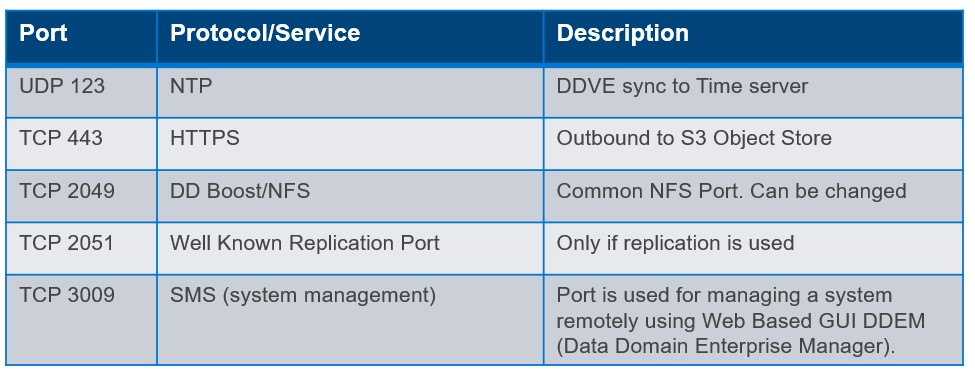
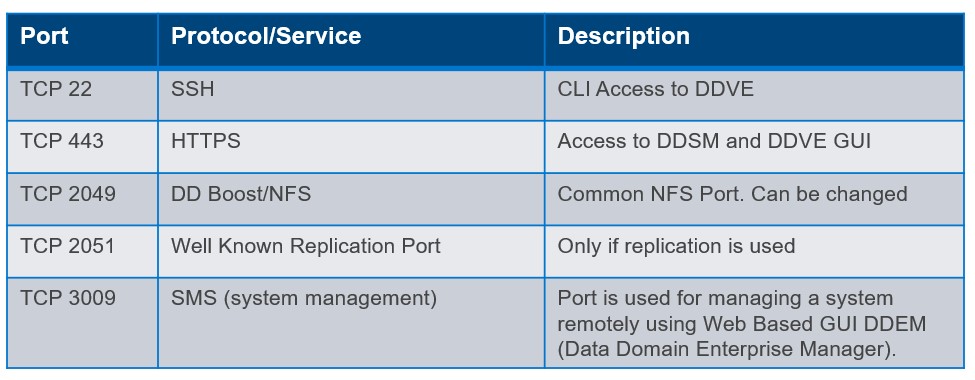
So earlier in this post we identified a couple rules that we need for S3 access outbound, SSH/HTTPS access inbound etc. In the following video example we will configure some more to enable other common protocol interactions such as DD Boost/NFS, Replication, System Management etc. Of course, the usual caveat applies here, please refer to official Dell Technologies Product Documentation ( I’ll post a few links at the bottom of the post), for the most up to date best practice and guidance. The purpose of this post is to examine the ‘why’ and the ‘how’, the specific ‘what’ is always subject to change !
Outbound Sample Ruleset
Inbound Sample Ruleset
Video Demo
Short and sweet this time, we will dive straight into creating a Security Group with the inbound/outbound ruleset as defined above. In the next post, we will do a longer video, from which we will go through the complete process from start to finish. VPC setup, IAM configuration, S3 Endpoint standup, Security Group configuration all brought together using Infrastructure as Code (IAC) and CloudFormation!
Quick Links
As promised a couple of handy references. Note: You may need Dell customer/partner privilege to access some content . Next up the full process end to end……
DISCLAIMER The views expressed on this site are strictly my own and do not necessarily reflect the opinions or views of Dell Technologies. Please always check official documentation to verify technical information.
Private connectivity from DDVE to S3 leveraging VPC S3 Endpoints.
Where we are at ?
In Part 1 we talked about securing the relationship between the DDVE instance and the target S3 instance. This was a permissions based approach leveraging the very powerful native IAM features and key management capabilities of AWS. A very Zero-Trust approach, truth being told… always authenticate every API call, no implicit trust etc.
We have a little problem though, our IAM stuff won’t work yet, but the reason is by design. Referring back to our original diagram ( Forgive the rather crude mark up – but it serves a purpose). Before we do that, just a brief word on the format of this series. The first few will introduce concepts such as IAM, VPC endpoints, Security Groups etc. The last in the series, will tie everything together and we will run through a full deployment, leveraging CloudFormation. First things first however!
Public versus Private Subnets
The DDVE appliance is considered a back-end server. It should never be exposed directly to the internet, hence that is why it sits in a ‘Private Subnet’, as per the diagram. A private subnet is one that is internal to the VPC and has no logical route in or out of the environment. At most it can see all the other internal devices within its local VPC. The purpose of course is that this minimises the attack surface by not exposing these devices to the internet.
Of course we have the concept of a ‘Public Subnet’ also. Referring to the diagram you can see our ‘Bastion host’ (fancy name for a jump box), sitting in the public subnet. As its name implies, it is facing the public or internet. There are various ways we can achieve this leveraging IGW, NAT etc., that we won’t delve into here. Suffice to say our ‘Bastion Host’ can reach the internet and devices private to the VPC.
The above is somewhat simplistic, in that we can get much more granular in terms of reachability leveraging Security Groups and Access Control Lists (ACLs). You will see how we further lock down the attack surface of the DDVE appliance in the next post leveraging Security Groups. For now, we have enough to progress with the video example below.
So what’s the problem?
S3 is a publicly accessible, region based AWS offering. It is accessed via what is called a ‘Public Service Endpoint’. To reach this endpoint an EC2 device must have access to this ‘Public Service Endpoint’, external to its VPC. By definition Private Subnets have no way out of their VPC so S3 access will fail.
Possible Solutions
Move the DDVE EC2 instance to the Public VPC.
I’ve included this as a possible option, clearly we won’t do this. Bad idea!
Leverage a NAT gateway deployed in the Public Subnet.
This is a valid option in that the private address is ‘obscured’ by the NAT translation process. It’s IP address still remains private and not visible externally.
Traffic from the private subnet would be routed towards the NAT device residing in the Public subnet
Once in the public subnet, then it can reach the S3 Public Service Endpoint via a route through the VPC Internet Gateway (IGW).
It is important to note here that even though traffic destined for S3 Public Service Endpoint, traverses the Internet Gateway, it does not leave the AWS network. So there is no security implication in this regard.
Considerations around using NAT
So yes we have a solution… well kind of. You have two NAT options
NAT Instance: Where you manage your own EC2 instance to host the NAT software. Technically you aren’t paying anything for the NAT service from AWS, but this is going to be complicated in terms of configuration, performance and lifecycle management. Even so, dependent on the throughput you require, you may need a beefy EC2 instance. This of course will be billed.
AWS NAT Gateway. An AWS managed service, so complications around performance, configuration, and lifecycle management are offloaded to AWS. of course the issue now becomes cost. You will be charged for the privilege. The cost structure is based on throughput, processing and egress, so if you are shifting a lot of data, as you may well be, then the monthly cost may come as a bit of a surprise. Scalability shouldn’t be too much of a concern, a gateway can scale to 100Gbps, but who knows!
A Better Solution: Leveraging VPC Gateway Endpoints (A.K.A S3 Endpoint)
Thankfully, the requirement for private subnet connectivity to regional pan AWS services is well known use case. AWS have a solution called Gateway Endpoints, to allow internally routed access to services such as S3 and DynamoDB. Once deployed, traffic from your VPC to Amazon S3 or DynamoDB is routed to the gateway endpoint.
The process is really very straightforward and is essentially just a logical routing construct managed by AWS directly. When a Gateway endpoint is stood up, a route to the S3 service endpoint ( defined by a prefix list), via the assigned gateway, is inserted in the Private subnets routing table. We will see this in more detail via the video example. Suffice to say the construct has many other powerful security features baked in leveraging IAM etc., that we will discuss during a later post. In summary:
Endpoints allow you to connect to AWS services such as S3 using a Private network instead of the Public network. No need for IGW’s, NAT Gateways, NAT instances etc., Plus they are free!
Endpoint devices are logical entities that scale horizontally, are highly redundant/available and add no additional bandwidth overhead to your environment. No need to worry about Firewall throughput or packet per second processing rates.
There are two types of endpoints. The first we have discussed here, the Endpoint Gateway. The second, the Interface Endpoint which leverages PrivateLink and ENI’s, and for which there is charge. These are architected differently but add more functionality in terms of inter region/inter VPC connectivity etc. In most, if not all cases for DDVE to S3, the Endpoint Gateway will suffice.
Video Demo
In the video demo we will follow on from the last post.
VPC setup is already in place, including private and public subnets, internet gateways, S3 bucket and the S3 IAM policy we created in the previous post.
We will deploy a bastion host as per the diagram, apply the IAM policy and test connectivity to our S3 bucket. All going well this will work.
We will then deploy an EC2 instance to mirror the DDVE appliance in the private subnet, apply the same IAM policy and test connectivity to the same S3 bucket. This will of course fail as we have no connectivity to the service endpoint.
Finally we will deploy a VPC Endpoint Gateway for S3 and retest connectivity. Fingers crossed all should work!
Next Steps
The next post in the series will examine how we lock down the surface attack area of the DDVE appliance even further using Security Groups.
DISCLAIMER The views expressed on this site are strictly my own and do not necessarily reflect the opinions or views of Dell Technologies. Please always check official documentation to verify technical information.
Followers of my blog will be very aware of the emphasis I have been placing on the emergence of Zero Trust. Back in October 2022, Dell announced the partnership with MISI and CyberPoint International to power the Zero Trust Center of Excellence at DreamPort to provide organisations with a secure data center to validate Zero trust use cases. In April of this year, Dell expanded upon this vision by announcing the Ecosystem of partners, security companies to create a unified Zero Trust solution
Zero Trust is a cybersecurity framework that automates an organization’s security architecture and orchestrates a response as soon as systems are attacked. The challenge, however, lies in implementing a complete solution guided by the seven pillars of Zero Trust. No company can do this alone.
Today marks the the 3rd part of this strategy. Project Fort Zero ,a new initiative that will deliver an end-to-end Zero Trust security solution, validated at the advanced maturity level by the U.S. Department of Defense, within the next 12 months. Project Fort Zero is a Dell-led initiative that brings together best-in-class technology from more than 30 companies, so we can design, build and deliver an end-to-end Zero Trust security solution. This solution will help global public and private-sector organizations adapt and respond to cybersecurity risks while offering the highest level of protection.
This is a big deal, Zero Trust is a challenge. Many vendors make claims around ‘Zero Trust Capable’. These are similar to statements such as ‘HD Ready’, for those of you who can remember the days of analog TV’s… or ‘Cloud Ready’. In reality, Zero Trust is a validated framework, that requires deep understanding across a broad portfolio of technologies and ever deepening set of skills to orchestrate, deliver and integrate a cohesive outcome. Project Fort Zero will help accelerate this process by delivering a repeatable blueprint for an end-to end solution that is based on a globally recognised validated reference architecture.
Policy Framework
At the heart of the solution, Zero trust is a a framework based on the mantra of ‘never trust, always verify’ or in my opinion ‘conditional trust’. Only trust something you know about (authenticate) and have determined its role and level of access (Authorize), based on the ‘Principle of Least Privilege’. Furthermore, ZTA mandates that the network is continuously monitored for change. Trust is not forever…. Zero Trust seeks to continuously authorize and authenticate based on persistent monitoring of the environment. Trust should be revoked if the principle of least privilege is not met.
ZTA does this by defining a policy framework built on business logic (Policy Engine) and implemented via a broad suite of technological controls using a control plane Policy Decision Point (PDP) and multiple Policy Enforcement Points (PEP) distributed across the environmental data plane. Zero Trust is not Zero trust without this policy framework. In practice this isn’t easy..
7 Pillars of Zero Trust
Dell will work with the DoD to validate the 7 Pillars and 45 different capabilities that make up the Zero Trust Architecture. These capabilities are further defined into 152 prescribed activities.
Can I go it alone?
For customers who may be mid-stream, have started there journey already or wish to evolve over time towards zero-trust, then Dell do offer products and solutions with native foundational built in Zero-Trust capabilities and a mature set of advisory services that provide an actionable roadmap for Zero trust adoption.
However, even a cursory review of the above 7 pillar schematic, gives an indication of the scale of the lift involved in delivering an end to end Zero Trust Architecture. The presence of multiple vendors across disparate technology siloes can present an implementation and integration burden, overwhelming to even the largest of our customers and partners. The intent of Project Fort Zero is to remove this burden from our customers and guarantee a successful outcome. If possible this is the more straightforward and preferable path.
Where to find more information?
Check back here for a continuation of my 7 Pillars of Zero Trust. This will be a technical deep dive into the technologies underpinning the above. As more information becomes available over the next couple of days I will edit this list on the fly!
DISCLAIMER The views expressed on this site are strictly my own and do not necessarily reflect the opinions or views of Dell Technologies. Please always check official documentation to verify technical information.
In a previous post, I talked pretty exhaustively about how we came to the point where the need for a Zero Trust Architecture has become obvious. The process of de-perimiterisation has, to all intents and purposes rendered many of the network based controls and the process around how they are implemented, whilst not quite obsolete, to a large degree ineffective. Certainly we have lost considerable trust in the ability of these controls to deal with the myriad of new threat vectors and the rapidly expanding and ever vulnerable attack surface.
So the answers are beginning to emerge in the form of of validated architectures or frameworks from NIST, CISA and the US Department of Defense, amongst others. I think in truth, they are really different sides to the same coin. In particular, all frameworks lean heavily into the concepts of authentication and authorisation, or more broadly speaking Identity Access Management (IAM).
If you recall from the last post, we called out the importance of IAM within a Zero Trust Architecture;
‘a systematic and robust ability to continuously authenticate and conditionally authorize every asset on the network, and to allocate access on the principle of ‘least privilege’. To that end, Identity and Access Management systems and processes (IAM) will step forward, front and center in a Zero Trust world’
Right, so the easy button…… IAM is the new Perimeter… and we are off to the races! Unfortunately not quite yet. As previously stated ZTA, is not a single product, or single uniform architecture, or a one size fits all approach. Identity Access and Management (IAM), is the bedrock component of ZTA, but is a complex, deep and mature subject in its own right, and equally heterogenous in terms of architecture diversity. In order to begin to understand how Zero Trust knits together (Pillars, Tenets etc.), we must at a very minimum understand some of the foundational concepts around Identity and Access Management (IAM). The purpose of this blog post.
Before we start exploring these foundational concepts then we need to note some realities:
Most if not all organisations have pre-existing IAM architectures that have matured over years, that mirror the de-perimeterisation effect. As the perimeters have been eroded via the journey to the public cloud and the edge, then so has the requirement for their traditional legacy IAM services to respond in kind. Where once life was easy with on premise MS Active Directory, now many customers are using more advanced techniques to facilitate these multi cloud use cases. For example, leveraging SAML for Federated Single Sign On (SSO) for SaaS based services such as Salesforce.com. It is not uncommon for organisations to have complex, non centralised and dispersed IAM architectures. It is also true to say IAM is a hot topic in IT, in its own right!
‘Lifting and Shifting’ these embedded IAM systems to facilitate the implementation of Zero Trust may present a challenge. Nothing is of course impossible, especially in greenfield, but these systems tend to be tightly engrained in existing business processes. The likelihood, is that it may be easier to find a way to integrate and augment, where feasible, pre-existing IAM systems into an emerging Zero Trust implementation, as much as practically possible. Indeed, a well constructed Zero Trust system should be capable of bridging together the multiple components of a non centralised IAM system.
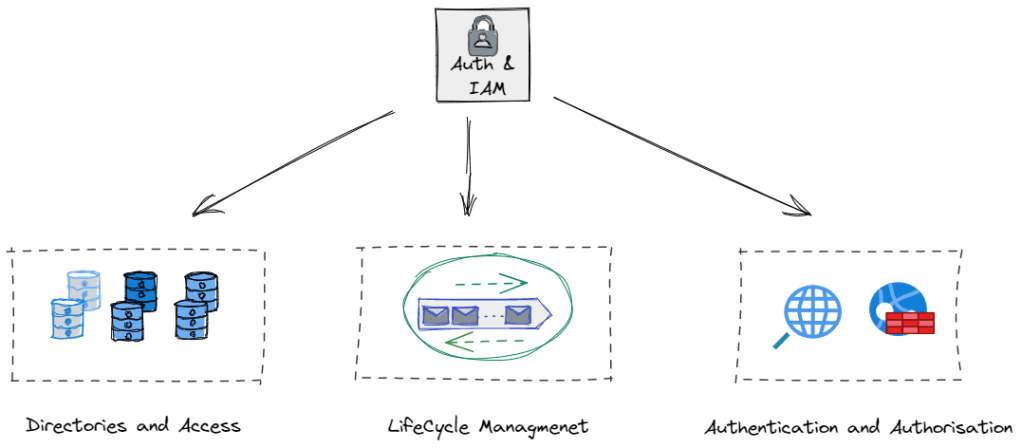
So… enough on Zero-Trust for a while and back to some foundational IAM concepts. I think everybody who will read this blog will have heard of the terminology, but hopefully the next sections will bring some of the ideas and constructs together. Clearly the below is not exhaustive. As mentioned IAM is a big area in its own right.
This blog is going to follow the travails of a fictional employee, Mary, who works in a typical enterprise running Microsoft in the back and front office. A bit naff I know, but hopefully the practical examples help somewhat.
1. Directories and Access.. where is my information stored and how do I get it?
Microsoft Active Directory
The days of the Yellow Pages may be long gone, but we still leverage the IT Phonebook. These take multiple types and forms but possibly the most familiar to many is Microsoft’s Active Directory (AD), of course there are Linux commercial alternatives such a Red Hat Directory Server and many different proprietary and open source directory services. For now though let’s concentrate on MS AD.
Keeping this very high level, AD will store attributes about both individual users, groups, laptops, printers, services etc, much like the Yellow Pages stores attributes about multiple entities, services, people and businesses. AD is then has a mechanism to structure this data ( domains, forests and tress), and protocols embedded in it to manage access, authentication and retrieval.
Lightweight Directory Access Protocol (LDAP)
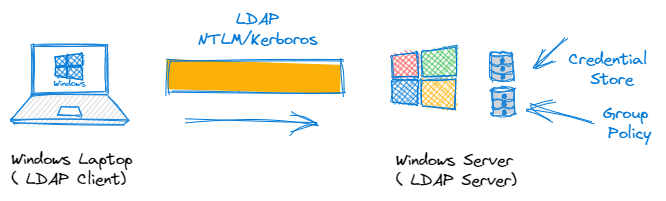
For security reasons, we don’t just allow anybody access to the phonebook, to browse, amend, query or retrieve data as they see fit. So we need a means of managing this. For this we use a lightweight client-server based protocol known as LDAP to do the job for us. Anybody who has searched for a domain attached printer for instance will have used LDAP. The LDAP Client (your laptop) queries the LDAP Server (MS AD) for the relevant objects. The server will of course seek to authenticate you, based on your network username and password, determine what level of permissions you have been administratively assigned, and then if authorised, return you a list of available network printers.
This is IAM in action. We have successfully ‘Identified’ the user, ‘Authenticated’ her via a network username and password and ‘authorised’ the correct level of access based on her AD group policy. This mechanism is still very widely deployed and LDAP based systems have expansive and far reaching support across identity, security and application vendors. Active Directory, is probably the most widely deployed LDAP implementation and is likely to be around for a long time to come yet.
What about the Cloud ? IDaaS
Sure, the above is very simplistic. Everything is cloud now right? Identity as a Service (IDaaS) are a family of offerings that offer cloud based directory services as well as wrap around authentication, authorization, Single Sign On, Federation and and life cycle management services. For now though, its enough to know they exist. Continuing the Microsoft theme we have Azure Active Directory for those who wish to push these services to the cloud. There is a nice link here, that goes through some of the comparisons between both on-premise and cloud based AD offerings.
2. Identity Life Cycle Management
What happens if Mary leaves the company or moves department?
We mentioned or at least alluded to at the start of the blog, the integration of IAM systems and the overall business process. The intersection between HR systems and IAM is very common, in order to manage the everyday process of employees ‘joining’, ‘moving’ through the business and eventually ‘leaving’. Good systems are built with the principle of least privilege at their core. Once a user or entity is assigned a level of privilege based on this principle, then the IAM system can continuously ‘authenticate, authorise and account’ for a users activity throughout the users lifecycle. This AAA concept is very old but is still foundational to IAM.
Of course, when a user leaves the company, or an entity is retired from use, then the principle of least privilege dictates that all access should be revoked ( No Access). This is why closed loop IAM systems are integrated tightly with HR systems to help share business logic and governance processes between them. Without stating the blindingly obvious, we need to know when Mary leaves the company and automate the response to that in terms of rights revocation etc.
The management of non human accounts and entities are of course a greater challenge, as their is unlikely to be a HR based revocation process in place. HR manage humans! These may be API accounts, with full admin rights for instance. Managing and providing governance around these accounts is of course a challenge that Zero Trust and Privileged Access Management (PAM) attempts to solve. More on that in a future blog…
3. Authentication and Authorisation
These concepts are really at the core of identity management systems. So lets start with some definitions:
Authentication:
The process whereby one or more factors of authentication – for example, a password, is used to validate that the identity claimed by the user or entity is known to the system. In our case the system being the MS AD Identity Store. A factor may be:
Something the user is: A fingerprint, Biometric data, location etc
Something they have: A hardware/software security token such as an RSA fob
Something they know: A Username/Password or answer to a challenge question, what was your first cat’s name?
So Multi-Factor Authentication (MFA) has been all the rage at the moment and is key component of Zero Trust. It very simply is the combination of two or more of the above when verifying credentials.
Authorisation:
This is the process of granting the right level of access to a resource once they have been authenticated. By its nature it is based on policy enforcement and context. For instance when Mary was onboarded, she may have been added to a certain AD group with specific access rights to the Finance/HR systems only. Policy is preventing her access to the Engineering domain.
What about Single Sign On (SSO)
SSO allows users to access different resources without multiple requests for credentials. In the case where Mary wants to map a new drive and browse a share within the AD forest then the Kerberos authentication protocol is used to manage the reuse of credentials throughout the forest whenever an access to a new resource is attempted.
What about the Cloud and connectivity to other stuff ?
So it is fair to say that the above is very simplistic overview of how IAM would work in a standard windows environment, but it does nonetheless introduce concepts around Directory Stores, IAM lifecycle Management, Authentication, Authorisation and Single Sign On (SSO).
With the explosion of cloud based apps and the growing popularity of other systems based on microservices and open source platforms, then we cannot just rely on the traditional mechanisms such as LDAP and RADIUS to deliver cross platform/entity identity authentication, authorisation and federation. I suspect many are familiar with the following terms and jargon, but may not quite understand quite what they do.
SAML (Security Assertion Markup Language)
Simply put, SAML is a protocol for authenticating to web applications. We touched on federation earlier, and SAML is an extension of this concept that allows us to federate identity information across entities and allow organisations to communicate and trust and provide single sign on capabilities for each others users.
So typically Mary will look to access resources within her own AD domain, Of course being in finance she will want to access an online service such as Salesforce.com. It would be really nice, if Mary, could leverage her existing AD username/password when logging onto Salesforce.com. Clearly this is advantageous in that it makes things much easier for Mary (she doesn’t have to scribble down another username/password pair), but it is a much more secure process for the company. Losing access credential data is generally is very serious. By limiting the amount of credentials and federating their use, administrators can control their distribution in a much more secure fashion. If their is a breach then the credential can be revoked centrally in the master directory (AD), access is then revoked everywhere including for SFDC access. Of course from a lifecycle perspective, if Mary were to leave, we don’t have to worry about what web applications she has access to, all rights can be revoked everywhere, quickly and efficiently.
So what just happened? At a very high level, and without getting into the SAML weeds…
Mary authenticates to her corporate Active Directory running Federation Services using her windows credentials as per normal ( remember Kerberos above). ADFS is known as the Identity Provider (IdP) in SAML parlance
AD FS returns a SAML ‘Assertion’ to Mary’s browser.
Mary’s browser submits the ‘assertion’ to Salesforce. Once Salesforce receives this assertion, because it comes from a trusted IdP, then Mary is logged on.
To say this is a very simplistic representation of SAML is an understatement, but the process is really as straightforward as the above. SAML has been a tremendously successful protocol, based on XML, since its inception in the mid 90’s. Indeed SAML 2.0 is the current version in use, and it has been around since 2005! We use it everyday, even outside the corporate world example above. Every time a website asks us do we wish to logon via Goggle, Facebook, Twitter etc., that is SAML using federated identity and SSO in action.
OAuth2
Oauth2 is a highly successful newer protocol developed by Google and Twitter in 2006. It was developed in response to the deficiencies of SAML when used on mobile devices. API driven and based on JSON versus XML and is thus much more lightweight. OAuth deals with ‘Authorisation’ only and delegates ‘Authentication’ tasks to another protocol OpenID Connect (OIDC). It is typically used to grant user access to information without exposing the password. Rather than giving away your username and password to a 3rd party app you grant the use of a token instead. what the…. 🙂
Ok so a practical example, without digging deep into the weeds. Mary is in work, and spending some time perusing LinkedIn (We are all guilty!)
Mary logs on and LinkedIn prompts her to add her google contacts as suggested new connections. Mary approves the request, This is OAuth2 in action. OAuth2 issues an ‘authorization’ token to approve one application to interact with another application on your behalf, without ever exposing your username/password. Another very common example, Mary could grant a photo printing service access to their private photos on Google Gallery, without ever having to share her username and password.
Technically, OAuth2 is an authorization protocol and not an authentication protocol. OpenID Connect, is an authentication protocol built top of OAuth2.
OpenID Connect (OIDC)
OIDC is an identity layer built on top of the OAuth2 framework. It allows third-party applications to verify the identity of the end-user and to obtain basic user profile information. OIDC uses JSON web tokens in lieu of usernames and passwords. Think of it like producing your passport at hotel check-in. The clerk accepts the passport as a lightweight and valid claim of your identity in order to check you in. They trust the passport authority to underpin Mary’s identity. It has nothing to do with authorisation however, the hotel clerk still references the booking information, to verify if Mary can access the executive lounge etc.
From a real world example, Mary sitting in the Hotel lobby decides to logon to Spotify on her mobile. Spotify prompts her to either logon directly or use her Facebook credentials , whereby she logs on to Facebook and Facebook passes her credentials to Spotify and she is quickly logged on. Like the hotel example, once logged on via OpenID Connect/Facebook, Spotify then carries out further authorisation checks to see if she has access to premium or audio books for instance.
Summing up
So what’s next…
To say the above is a very high level simplistic overview of IAM is an understatement, clearly when you dig a bit deeper, some of the protocol interdependencies are indeed quite complex. Nonetheless, hopefully we have provided some grounding before we can delve in a conversation around Zero Trust in earnest. In particular, the 7 pillars of the DoD Zero Trust Framework, and in particular the next post in the series, concentrating on Pillar 1: The User
What is Directive (EU) 2022/2555 and why it matters?
Everybody should be aware of the White House Executive order (EO 14028) and the mandate to strengthen security across the federal landscape and by definition the enterprise. However, on this side of the pond, the EU in somewhat typically understated fashion have introduced their own set of directives, that are equally impactful in terms of depth and scope.
NIS 2 was published on the 27th December 2022 and EU Member States have until 17 October 2024 to adopt and publish the provisions necessary to comply with the Directive. A short runway in anybody’s language.
Note the first word in the title, ‘Directive’. This is not a recommendation, and holds comparable if not more weight within the EU, than the White House Executive Order does in the U.S.
There will be a significant widening of scope as to what organisations will be affected by the new directive, as compared to NIS1. Operators of services such utility providers, Data Centre service providers and public government services will be deemed “essential” at a centralised pan European level using the ‘size-cap’ rule. So once, you are deemed as a medium or large entity operating within the sector or providing services covered within the sector, you are bound by the regulation, no matter what member-state you reside in. Member states no longer have the wiggle room to determine what qualifies or doesn’t qualify, with one interesting exception, they can circumvent the size-cap rule to include smaller entities in the relevant sectors. So you have ‘wiggle room’ as long as it means regulating more versus less! Indeed, in some instances, size won’t matter and the ‘size-cap rule’ will not apply at all, once the service is deemed critically essential. e.g. public electronic communications.
Other critical sectors will be defined as ‘important’, such as the manufacture of certain key products and delivery of certain services e.g. Postal Services. They will be subject to less regulatory oversight than the “essential” category, but compliance will still be mandatory and the undertaking will still be significant.
So what areas does the directive cover, I will defer to a future post(s) to explore in a little more depth what this may mean, but Article 21 Paragraph 2 covers some of the following. I briefly flirted with the idea of quoting the entire “Paragraph 2” but I promised myself to keep this brief. Key message here is that this ‘Directive’ is all encompassing and far reaching, across both process, procedures and technical controls, I have highlighted/paraphrased just a few here, because they re-enforce much of what we have talked about in this blog series thus far:
Article 21 Paragraph 2 – Interesting Snippets
(c) Business Continuity, backup management, disaster recovery and crisis management.
(d) Supply Chain security, including the security-related aspects concerning the relationships between each entity and its direct suppliers and service providers.
(f) Policies and procedures regarding the use of cryptography and where appropriate encryption.
(j) The use of multi-factor authentication or continuous authentication solutions, secured voice, video and text communications and secured emergency communications systems within the entity, where appropriate.
Clearly (c) needs to be framed in response to the prevalence and ongoing negative impact of ransomware. This blog focused late last year on the Dell CR offering and there is much more to come in this regard over the next couple of months. Remembering of course the distinction between Business Continuity (BC) and traditional Disaster Recovery(DR), as many organisations are discovering to their cost after the ‘cyber breach’ fact. DR does not guarantee BC in the presence of a ransomware attack! We need guarantees around data immutability, cyber resilience and leverage vaulting technology if and where we can.
We have also touched in this blog around Dell Secure Software Development (SDL) processes and end to end secure supply chain. Here is thelinkback to the great session that my colleagues Shakita and Marshal did in December 2022, on the work Dell is doing around SBOM for instance. More on this broader topic in the future posts.
Finally, its hard read anything on this topic without being struck by the focus on policy, encryption, multi-factor/continuous authentication and network segmentation. Sounds very ‘Zero-Trustesque’, that’s because NIS2 shares many of the same principles and tenets. Indeed, I’ll finish with a direct quote from the directive introductory paragraph.
More to come……
Essential and important entities should adopt a wide range of basic cyber hygiene practices, such as zero-trust principles, software updates, device configuration, network segmentation, identity and access management or user awareness, organise training for their staff and raise awareness concerning cyber threats, phishing or social engineering techniques. Furthermore, those entities should evaluate their own cybersecurity capabilities and, where appropriate, pursue the integration of cybersecurity enhancing technologies, such as artificial intelligence or machine-learning systems to enhance their capabilities and the security of network and information systems.
DISCLAIMER The views expressed on this site are strictly my own and do not necessarily reflect the opinions or views of Dell Technologies. Please always check official documentation to verify technical information.
Just after the New Year, I caught up with a work colleague of mine and I started to chat about all the good work we are doing in Dell with regards Zero Trust and the broader Zero Trust Architecture (ZTA) space. Clearly he was very interested (Of course!!). We talked about the Dell collaboration with MISI (Maryland Innovation Security Institute) and CyberPoint International at DreamPort, the U.S Cyber Command’s premier cybersecurity innovation facility. There, Dell will power the ZT Center of Excellence to provide organisations with a secure data center to validate Zero Trust use cases in the flesh.
Of course, me being me, I was on a roll. I started to dig into how this will be based on the seven pillars of the Department of Defense (DoD) Zero Trust Reference Architecture. Control Plane here, Macro-segmentation there, Policy Enforcement Points everywhere!
Pause… the subject of a very blank stare…. Reminiscent of my days as a 4 year old. I knew the question was coming.
“But Why Zero Trust?”
This forced a pause. In my defense, I did stop myself leaning into the casual response centered on the standard logic: Cyber attacks are on the increase, ransomware, malware, DoS, DDoS, phishing, mobile malware, credential theft etc., ergo we must mandate Zero-Trust. Clearly this didn’t answer the question, why? Why are we facing more cyber related incidences and why shouldn’t I use existing frameworks such as ‘Defense in Depth’? We have used them for decades, they were great then, why not now? What has changed?
Of course a hint lies in the title of this post, and in particular the very first line of the DoD Reference Architecture guide.
“Zero Trust is the term for an evolving set of cybersecurity paradigms that move defenses from static, network-basedperimeters to focus on users, assets, and resources. Zero Trust assumes there is no implicit trust granted to assets or user accounts based solely on their physical or network location (i.e., local area networks versus the Internet) or based on asset ownership (enterprise or personally owned)”
So the goal is to move from ‘static, network-based perimeters’ to ‘focus on users, assets and resources’. However, as you may have guessed, the next question is……
“But Why?”
I think we can formulate a relevant coherent answer to this question.
The Problem of De-Perimeterisation
Traditional approaches to network and infrastructure security are predicated on the idea that I can protect the perimeter. Stop the bad stuff at the gate and only leave the good stuff in leveraging firewalls, ACL’s, IPS and IDS systems and other platforms. ‘Defense in Depth’ has become a popular framework that enhances this network perimeter approach, by adding additional layers on the ‘inside’, another firewall here another ACL there. Just in case something gets through. Like a series more granular sieves, eventually, we will catch the bad stuff, even if it has breached the perimeter.
This approach of course has remained largely the same since the 1990’s, for as long as the Network firewall has existed. ( in fact longer but I choose not to remember that far back!)
The ‘noughties’ were characterised by relative simplicity:
Applications all live in the ‘Data-Center’ on physical hardware. No broad adoption of virtualisation just yet. What’s born in the DC stays in the DC for the most part. Monolithic workflows.
Hub/Spoke MPLS based WAN and Simple VPN based remote access. Generally no split tunnels allowed. In other words to get to the internet, when ‘dialed-in’ you needed to reach it via the corporate DC.
Fledgling Internet services, pre SaaS.
We owned pretty much all our own infrastructure.
In this scenario, the network perimeter/border is very well defined and understood. Placing firewalls and defining policy for optimal effectiveness is a straightforward process. Ports were opened towards the internet but the process was relatively static and manageable.
Interestingly, even back then we could possibly trace the beginnings of what we now know of Zero-Trust movement. In 2004, the Jericho Forum, which later merged into the Open Group Security Forum, remarked rather prophetically;
“The traditional electronic boundary between a corporate (or ‘private’) network and the Internet is breaking down in the trend which we have called de-perimeterisation“
And this was almost 20 years ago, when things were….. well, simple!
Rolling on to the next decade.
Things are beginning to change, I had to put a little thought into where I drew my rather crude red line representing the network perimeter. We now have:
The rise of X86 and other types of server virtualisation. All very positive but lending itself to proliferation of ‘virtual machines’ within the DC. Otherwise known as VM sprawl. Software Defined Networking and Security ‘Defense in Depth’ solutions soon followed such as VMware NSX to manage these new ‘East-West’ flows in the Data Center. Inserting software based firewalls representing the birth of micro-segmentation as we know it.
What were ‘Fledging’ Web based services have now firmly become ‘Business Critical ‘ SaaS based services. How we connected to these services became a little bit more complicated, indeed obfuscated. More and more these were machine to machine flows versus machine to human flows. For instance, my internal app tier pulling from an external web based SaaS database server. The application no longer lived exclusively in the DC nor did we have exclusive ownership rights.
More and More, the remote workforce were using the corporate DC as a trombone transit to get to business SaaS resources on the web. This started to put pressure on the mandate around ‘thou must not split-tunnel’, simply because performance was unpredictable at best, due to latency and jitter. (Unfortunately we still haven’t figured out a way to speed up the speed of light!)
Ultimately, in order for the ‘Defend the Perimeter’ approach to be successful we need to:
‘Own our own infrastructure and domain.‘ Clearly we don’t own nor control the Web based SaaS services outlined above.
‘Understand clearly our borders, perimeter and topology.’ Our clarity is undermined here due to the ‘softening’ of the split-tunnel at the edge and our lack of true understanding of what is happening on the internet, where our web based services reside. Even within our DC, our topology is becoming much more complicated and the data flows are much more difficult to manage and understand. The proliferation of East-West flows, VM sprawl, shadow IT and development etc. If an attack breached our defenses, it is difficult to identify just how deep it may have gotten or where the malware is hiding.
‘Implement and enforce our security policy within our domain and at our perimeter’ Really this is dependent on 1 and 2, clearly this is now more of a challenge.
The Industry began to recognise the failings of the traditional approach. Clearly we needed a different approach. Zero Trust Architectures (ZTA), began to mature and emerge both in theory and practice.
Forrester Research:
2010: John Kindervag coined the phrase ‘Zero Trust’ to describe the security model that you should not implicitly trust anything outside or inside your perimeter and instead you must verify everything and anything before connecting them to the network or granting access to their systems.
2014: BeyondCorp is Google’s implementation of the Zero-Trust model. Shifts access controls from the network perimeter to individual users, BeyondCorp enables secure work from any location without the need for a traditional VPN
Because the perimeter is everywhere, the perimeter is in essence dead…….
I refrained from the red marker on this occasion, because I would be drawing in perpetuity. The level of transformation that has taken place over the last 4-5 years in particular has been truly remarkable. This has placed an immense and indelible strain on IT Security frameworks and the network perimeter, as we know them. It is no longer necessary to regurgitate the almost daily stream of negative news pertaining to cyber related attacks on Government, Enterprise and small business globally, in order to copperfasten the argument, that we need to accelerate the adoption of a new fit for purpose approach.
In today’s landscape:
Microservice based applications now sit everywhere in the enterprise and modern application development techniques leveraging CI/CD pipelines are becoming increasingly distributed. Pipelines may span multiple on-premise and cloud locations and change dynamically based on resourcing and budgetary needs.
Emerging enterprises may not need a traditional DC as we know it or none at all, they may leverage the public cloud, edge, COLO and home office exclusively.
The rise of the Edge and enabling technologies such as 5G and Private Wireless has opened up new use cases and product offerings where applications must reside close to the end-user due to latency sensitivity.
The continued and increasing adoption of existing established enterprises of ‘Multi-Cloud’ architectures.
The emergence of Multi-Cloud Data mobility. User and application data is moving, more and more across physical and administrative boundaries based on business and operational needs.
The exponential growth of remote work and the nature of remote work being ‘Internet First’. More often than not, remote users are leveraging internet based applications, SaaS and not leveraging any traditional Data Center applications. Increasingly a VPN less experience is demanded by users.
Ownership it shifting rapidly from Capex to dynamic, ‘Pay As You Use/On-demand’ Opex based on-premise cloud like consumption models, such as Dell APEX.
So, if you recall, the three key controls required to implement a ‘Perimeter’ based security model include:
Do I own the Infrastructure? Rarely at best, more than likely some or increasingly none at all. Indeed many customers want to shift the burden of ownership completely to the Service Provider (SP).
Do we understand clearly our border, perimeter and topology? No. In a multi-cloud world with dynamic modern application flows our perimeter is constantly changing and in flux, and in some cases disappearing.
Can we implement security policy at the perimeter? Even if we had administrative ownership, this task would be massively onerous, given that our perimeter is now dynamic at best and possibly non existent.
So where does that leave us? Is it a case of ‘out with the old in with the new’? Absolutely not! More and more security tooling and systems will emerge to support the new Zero Trust architectures, but in reality we will use much of what already exists. Will we still leverage existing tools in our armoury such Firewalls, AV, IPS/IDS, and Micro-segmentation? Of course we will. Remember ZTA is a framework not a single product. There is no single magic bullet. It will be a structured coming together of the people, process and technology. No one product or piece of software will on its own implement Zero Trust.
What we will see though emerge, is a concentration of systems, processes and tooling in order to allow us deliver on the second half of the first statement in the DoD Reference Architecture Guide.
“Zero Trust assumes there is no implicit trust granted to assets or user accounts based solely on their physical or network location (i.e., local area networks versus the Internet) or based on asset ownership (enterprise or personally owned)”
If we can’t ‘grant trust’ based on where something resides or who owns it, then how can we ‘grant trust’ and to what level?
The answer to that lies in a systematic and robust ability to continuously authenticate and conditionally authorize every asset on the network, and to allocate access on the principle of ‘least privilege’. To that end, Identity and Access Management systems and processes (IAM) will step forward, front and center in a Zero Trust world. ( and into the next post in this Zero Trust series…..)
DISCLAIMER The views expressed on this site are strictly my own and do not necessarily reflect the opinions or views of Dell Technologies. Please always check official documentation to verify technical information.







 Cablestoclouds.blog